Even after an armed conflict ends, countries need about 20 to 30 years to recover their environmental performance.
Dr. Florian Krampe
Director, Climate Change and Risk Programme
Stockholm International Peace Research Institute (SIPRI)
What we found
Joakim Kreutz, Tobias Ide and I carried out the first global study of what armed conflict does to the environmental performance of countries. We combined the Yale Environmental Performance Index, which rates 180 countries on air quality, drinking water and sanitation, waste, biodiversity, emissions and other measures, with the Uppsala Conflict Data Program’s record of armed conflicts since 1946, and looked at the years 2006 to 2020.
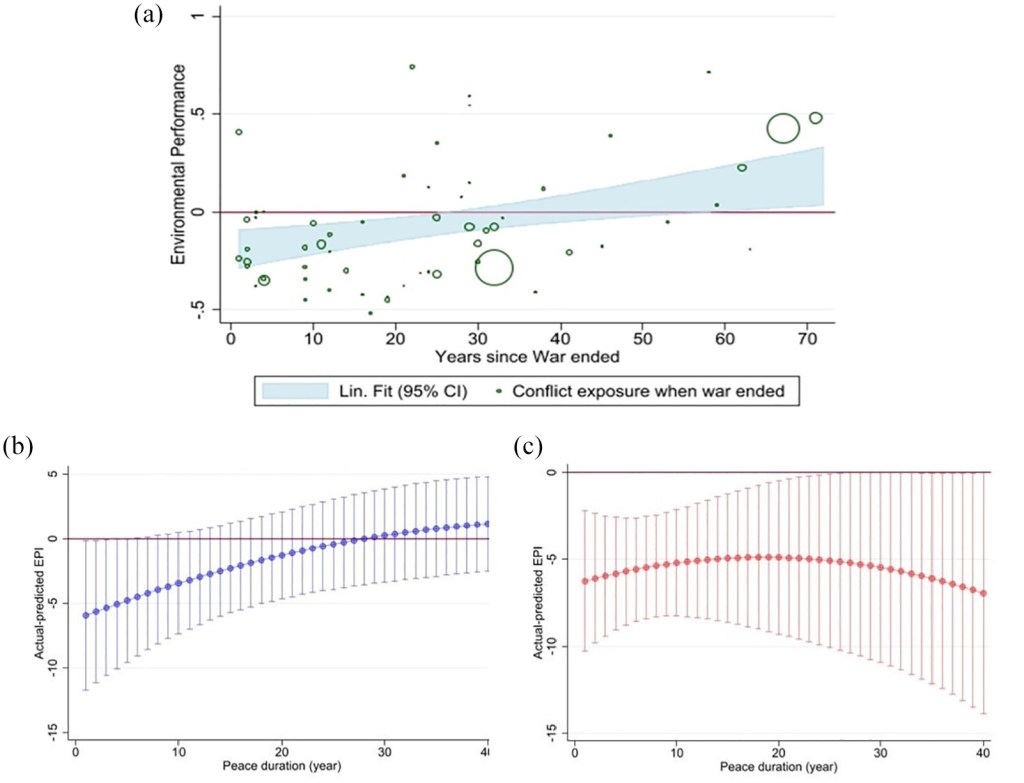
Countries in armed conflict score on average 12 per cent lower than countries at peace. The damage grows with the length and severity of the fighting, and it holds when we compare each country with what its geography, economy and political institutions would lead us to expect.
The effect lasts well beyond the fighting. Countries that have been at peace for less than 20 years still score almost 15 per cent lower than countries with a longer peace, and it takes about 20 to 30 years for environmental performance to recover. Recovery is far more likely after short, limited conflicts than after long and destructive ones.
Why it matters
This matters first for prevention. Short, contained fighting leaves comparatively little lasting damage, while long and intense wars leave damage that outlives the peace agreement by decades, so stopping escalation is also a way of protecting the environment.
It also matters for reconstruction. Governments and their international partners are often tempted to relax environmental standards to revive the economy, as in Kosovo, where the international community refurbished lignite power plants, and international environmental funding tends to favour stable countries. Environmental recovery therefore has to be planned and financed from the start. Ukraine, Sudan and Gaza will face the same choices.
Finally, post-conflict countries carry a double burden. A warming climate adds stress to environments that war has already weakened, and it does so where the risk of renewed conflict is highest. Climate change does not cause wars. It changes what it takes to prevent them.
Cite as
Krampe, F., Kreutz, J. and Ide, T. (2026) ‘Armed conflict causes long-lasting environmental harms’, Environment and Security, 4(1), pp. 3–17. First published online 11 March 2025. doi:10.1177/27538796251323739 (open access).
The most-read article in Environment and Security over the past six months, and its second most-cited of the past three years (journal website, October 2026).
Get in touch
For briefings, interviews or work on this research. Tell me who you are and what you need.

