Florian Krampe
Senior Research and Programme Director, SIPRI
Climate change does not cause wars. It changes what it takes to prevent them.
Seventeen years of field evidence in Somalia, Nepal, Kosovo and the Arctic, and one argument that follows from it: almost no security institution has adjusted to a planet that no longer holds still. I direct the Climate Change and Risk Programme at SIPRI in Stockholm.
In the press







Briefings delivered to the UN Security Council, NATO, the African Union, the OSCE, the European Union’s Political and Security Committee, the Swedish Defence Commission, and corporate leadership groups across Europe and Asia.
The talk
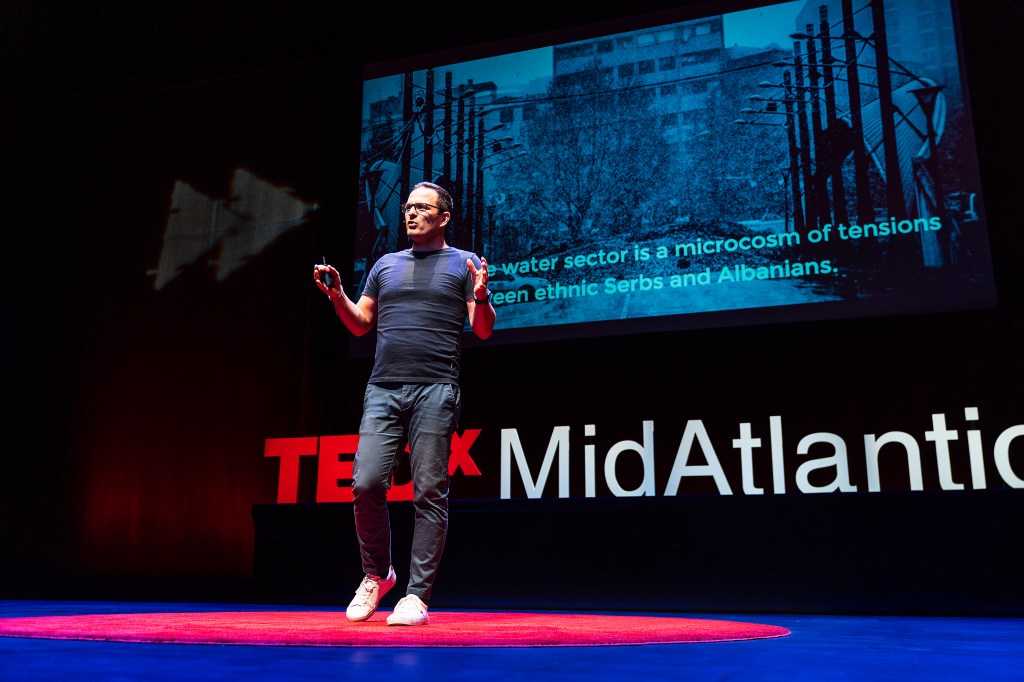
How can climate change help us build a more peaceful world?
TEDxMidAtlantic, Washington D.C. A cracked riverbed, a drought, people on the move — and the headline writes itself. Eleven minutes on why the deterministic story is wrong, and what the evidence from Kosovo, Nepal and Somalia says instead.
For public lectures, universities, festivals and climate or development conferences. Available as a longer keynote.
What I speak about
The fortress on quicksand
Defence spending across Europe is heading toward five per cent of GDP, and it is being planned against a baseline that no longer holds. Thawing permafrost buckles radar foundations. Changing thermal layers scramble sonar. A runway buckled by permafrost is not an environmental issue; it is a loss of capability. Investment made against the old physics buys readiness that will not hold.
For defence ministries, security conferences, re-insurers and institutional investors.
Why the transition breaks politics first
The danger is not the shock. It is the gap between what the transition costs and what the state will absorb — and where the state fails to absorb it, something else moves in and collects the legitimacy. Steelworkers in 1980s Duisburg felt sacrificed on the altar of free trade; today’s households feel sacrificed on the altar of net zero. It does not matter whether you transition because you like trees or because diesel costs five euros a litre. Transition is above party politics because it is a security question.
For political foundations, industry associations and German-language audiences. Delivered in German.
What actually prevents wars over water
No war has been fought directly over water. What fails is the institutions that were meant to manage it, and they fail slowly, through the erosion of trust rather than the drying of a river. Drawn from field evidence in Kosovo, Nepal and Somalia, and from a century of transboundary water data. Why a governance-first approach outperforms both engineering and deterrence.
For UN and multilateral audiences, development institutions and diplomatic academies.
The climate risk already on your balance sheet
Environmental stress does not cause instability directly. It reveals which institutions were already too fragile to absorb it — and that is where supply chains break, procurement stalls and assets strand. The difference between disruption and resilience is rarely the severity of the drought. It is the quality of the institutions managing it, and that is measurable before the loss, not after.
For corporate boards, industrial and energy groups, and investment forums.
About
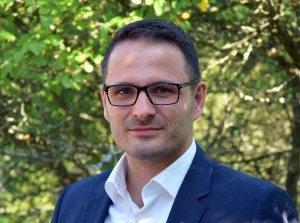
Florian Krampe is Senior Research and Programme Director at the Stockholm International Peace Research Institute (SIPRI), where he directs the Climate Change and Risk Programme and serves as Director of Studies for Peace and Development. He has spent seventeen years on the security consequences of a changing planet, with field evidence from Somalia, Nepal, Kosovo and the Arctic.
He has briefed the UN Security Council, NATO, the African Union, the European Union, the OSCE and corporate leadership groups across Europe and Asia. His research appears in International Affairs, World Development, Global Environmental Politics and Cooperation and Conflict, and his commentary in the Financial Times, Nikkei Asia and the World Economic Forum. He has been quoted in The New York Times, The Guardian, The Washington Post, Reuters, Der Spiegel, Deutsche Welle and Foreign Policy.
His 2019 SIPRI Policy Brief found that eight of the ten countries hosting the most multilateral peace operations personnel in 2018 were located in areas highly exposed to climate change, a finding the UN Secretary-General cited at the Security Council in February 2021.
His book Kinetic Earth: How a Changing Planet Is Rewriting the Rules of War, Peace and Power is forthcoming. He holds a PhD from Uppsala University, where he remains affiliated with the Department of Peace and Conflict Research, and lives in Uppsala.
Request a talk or briefing
Keynotes, closed-door briefings and policy sessions, in English or German. Tell me the date, the room, and what you need the audience to leave with. Hosts cover travel and accommodation.


